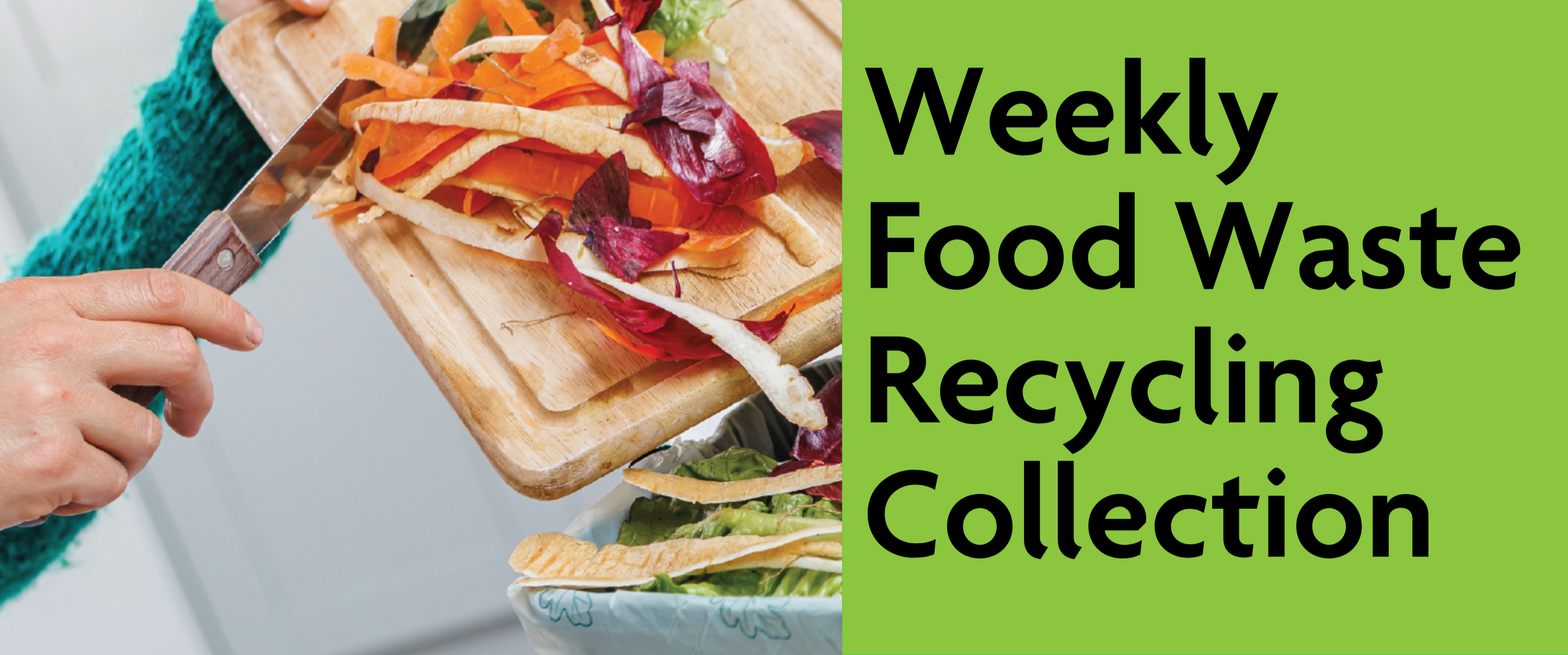
The weekly food waste collections have now started. You can look up your collection day on the bin calendar for your property.
If you haven’t received your food waste caddy yet, please let us know, and we will arrange a delivery.
You can either call us on 01480 388382, email us at wasteminimisation@huntingdonshire.gov.uk or use the online form.
Please include your full address so we can get this resolved as quickly as possible.
-
If you receive communal waste collections, you can find out more information here.
-
If you are a business and wish to find out more about food waste collections at your premises, please visit the Commercial Food Waste and Recycling page.
Why is the service being implemented?
Food waste collection is set out in national legislation and not just a local decision. Under the Environment Act 2021, councils across England will be legally required to collect food waste separately from all households and businesses. The aim is to make recycling easier, more consistent, and available to everyone, no matter where they live.
The government has provided funding to local councils so that every household and communal property (such as blocks of flats) will have access to weekly food waste collections, free of charge. This funding helps cover the cost of new bins, vehicles and recycling facilities, so the service can be introduced without adding to Council Tax bills.
Why is this happening?
-
A lot of waste that is thrown away is food - around a third of the average household bin
-
Food waste left in landfill produces methane, a harmful greenhouse gas. Recycling it through anaerobic digestion turns it into biogas and fertiliser instead
-
The law ensures every council provides the same core recycling services, so residents across England have equal opportunities to recycle
-
Diverting food waste from landfill reduces disposal costs, making waste services less expensive and more efficient overall.
How does it work?
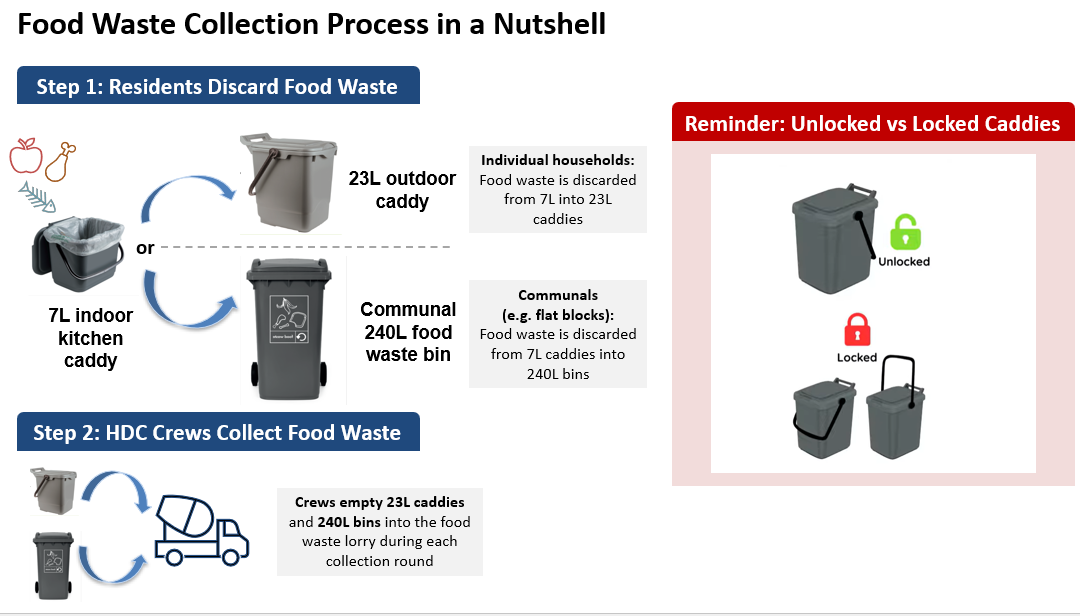
By the end of March 2026, all households will receive a 7-litre grey indoor caddy and an external 23-litre grey food waste bin for free.
Flats with communal bins will receive a small (7-litre) food waste kitchen caddy which each resident should empty into the larger (240 litre) outdoor communal food waste bin. The communal food waste bin will be emptied weekly by the collection crews.
From the week commencing 30 March 2026 we will collect your food waste every week on the same day as your normal waste and recycling collections.
Please put your outdoor food waste recycling bin, with the handle in the locked position, at the edge of your property with your other waste or recycling.
Separate vehicles will collect your food waste caddy - this may take place at different times to other collections.
While you are not required to use liners, you can use either compostable or non-compostable liners within your indoor and outdoor caddy. Please note that we will not be providing liners.
What can I put in my kitchen caddy?
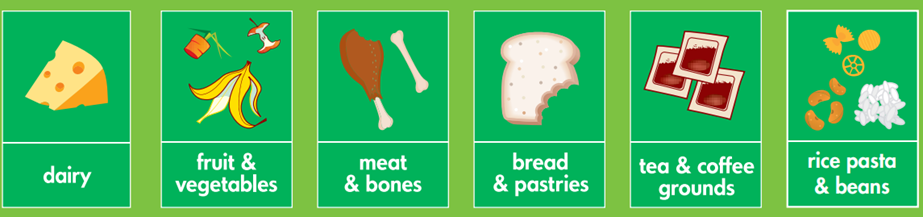
You can place any type of food inside the 7-litre indoor caddy.
This includes raw meat, cooked meat and bones, fish, cooked fish and bones, gristle, dairy products, cheese and eggs, teabags and coffee grounds, rice, pasta and beans, baked good (such as bread, cakes and pastries), raw vegetables, cooked vegetables, whole fruit and peelings and pet food.
Please do not put any of the following materials in your food waste caddy:
-
Liquids such as milk, oil or fat
-
Plastic film or packaging
-
Garden waste
-
Pet waste (bedding, litter, faeces).
Can I use liners?
Yes, you can. However, using a liner is optional. You can use any type of compostable or non-compostable bin liner (please do not use thick plastic bags, such as bags for life or black bin bags) or newspaper. Or you can simply put the food directly in, whichever you prefer.
You can use liners for both the indoor 7-litre caddy, and the outdoor 23-litre caddy.
Even without a liner, the caddy is easy to use and clean.
How do I use my food caddies?
-
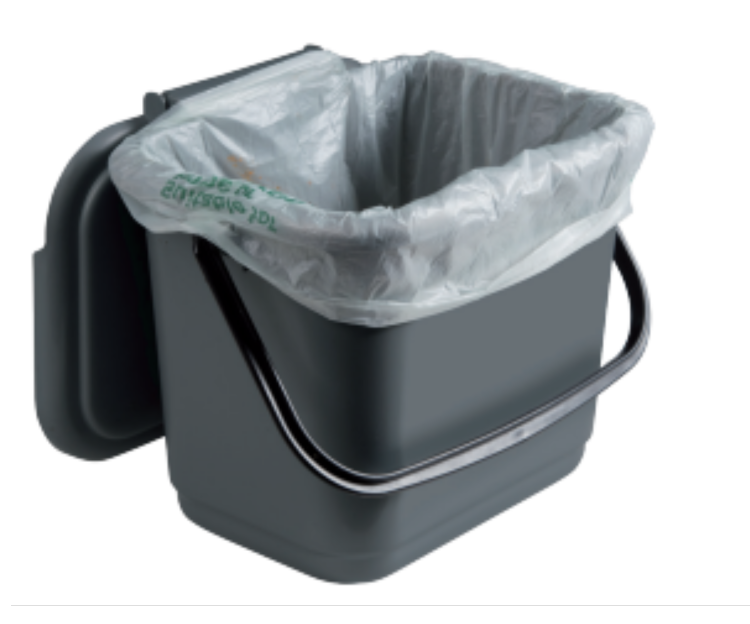
Line your indoor 7-litre caddy. You can leave it in a convenient location (for example, your kitchen worktop)
-
Fill it with food waste
-
When your 7-litre caddy is full, discard bagged and tied up food waste or loose food waste (whichever you prefer) into either the 23-litre caddy or the 240-litre communal food waste bin. Please empty and wash your indoor caddy regularly
-
Lock your 23-litre bin by keeping the handle in an upright locked position. This will keep it secure from animals, including birds
-
Non-communal households only - Put your outdoor 23-litre waste bin (with the handle in the upright locked position) out for collection by 6.30 am on or before your collection day.
Keeping your caddies clean
To keep your food caddy clean, regularly empty it into your outdoor food bin. You may choose to use a liner or line the caddy with newspaper.
You can put your food caddy into your dishwasher or give it a rinse after washing up. We empty your outdoor food bin weekly, and it has a lockable lid which stops smells getting out and any animals getting in. Keeping your outdoor caddy clean will also help prevent smells or mould developing.
Will you return for my missed food caddy?
We are not able to return for any missed food caddy collections. Please report details on the missed bin form - this information will help us to monitor and improve our new service.
What should I do if my food caddy is rejected?
If your food caddy is rejected due to contamination, it will not be emptied until your next scheduled collection. To avoid your caddy being rejected again, please remove any items contaminating the food waste.
The following items must not be placed in your food caddy:
-
liquids
-
garden waste
-
plastic film or packaging
-
pet waste.
Will the food waste bins blow away in strong winds?
We know how windy it can get. When it's stormy, we suggest putting your bin somewhere sheltered until collection day. Always make sure the lid is locked properly.
How do I stop animals or pets getting into the bin?
Each caddy has a locking handle.
To lock it, just move the handle forward and upright. You will see a sign on the caddy lid showing how to do this. This keeps the lid secure so animals or pets cannot get in.
What happens to the food waste?
The food waste will be recycled through a process called anaerobic digestion (AD).
Here’s what happens:
-
In sealed tanks, microbes digest the food without oxygen
-
This produces biogas, which is turned into renewable electricity, heat or green gas for homes, businesses and vehicles
-
The leftover material is rich in nutrients and spread on farmland to grow more food.
What are the benefits of using a food waste bin?
-
Lower waste processing costs: Waste is heavy and expensive to dispose of. By keeping it separate from other waste streams, the cost of processing is greatly reduced
-
Household savings: Having a separate bin makes it clear how much food is being wasted, helping you cut down on food waste and save money on buying food in the first place
-
Environmental benefits : About a third of what goes into a normal rubbish bin is food waste. If it ends up in landfill, it creates harmful greenhouse gases. But if it’s recycled through anaerobic digestion (AD), it’s turned into biofuel and fertiliser.
Can I compost my own food?
Yes! However, you should only compost garden waste and uncooked vegetables and fruit (such as peelings and skins) as well as coffee grounds and tea bags.
Subsidised home composters can be purchased through our partner at GetComposting
The subsidy applies to a maximum of 2 compost converters per household. Please visit GetComposting, enter your postcode, select Blackwall 220 Litre Black Compost Converter and the discount will be automatically applied.
All non-compostable food waste, such as meat, fish, small bones, cooked food and dairy products can go into your food waste bin.
Can I opt out of food waste collections?
Food waste caddies are being delivered to all properties as part of the new recycling service.
We understand some residents may feel they don’t need a food waste collection, but we wouldn’t encourage refusing the service.
Under the Environment Act 2021, all councils in England are required to offer weekly food waste collections. This ensures a fair and consistent service across the country.
Reasons to use the new food waste service
Even small amounts of food waste add up. If food goes into your general rubbish, it’s more likely to end up in landfill, where it produces harmful greenhouse gases. When recycled separately, it’s turned into biogas and natural fertiliser instead.
Using the food waste bin makes it easier to see how much food is being thrown away. Many households find this helps them reduce waste and save money on shopping.
When food waste is separated, it reduces the amount of heavy, costly rubbish in general waste bins. This helps keep disposal costs down for the whole community.
I don't want a food caddy
As part of the rollout, each household will be provided with a food waste caddy to support the recycling of food waste.
We're unable to exclude individual addresses from the delivery list, as the council is required to ensure that all properties receive a food caddy in line with statutory requirements.
How will this work for those who have to use sacks instead of a normal collection?
If you don’t have a wheeled bin and normally use sacks for your rubbish, you’ll still be able to recycle your food waste easily. Every household will be provided with a 7-litre and a 23-litre food waste caddy.
The caddy is compact and designed for weekly collections, so it won’t take up much space.
All properties will benefit from the same weekly service.